|
|
 |
|
Formerly The Hub |
|
|
|
|
|
|
|
Welcome to The Weekly, a Bluedot Living newsletter that gathers good news, good food, and good tips for living every day more sustainably. |
|
Welcome to The Weekly, a Bluedot Living newsletter that gathers good news, good food, and good tips for living every day more sustainably. |
|
If you purchase anything via one of our links, including from Amazon, we may earn a small commission. All Dear Dot illustrations by Elissa Turnbull. |
|
|
|
|
SIMPLE / SMART / SUSTAINABLE / STORIES |
 |
|
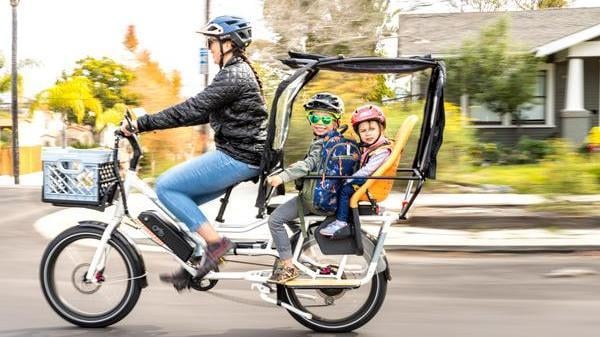
“My home office window faces the house where my dear friends Stacy and Justin live with their kids,” writes Jim Miller in this story from our archives. “If I’m up early enough, I usually see one of the two adults pedal off on their Rad Power Radwagon 4 e-bike. … It’s an impressive sight: the large electric bike glides confidently up the hill, with Benjamin on the back seat, and Siena perched in her safety seat.” Frugality, environmentalism, and just plain fun (Siena hates car trips now): all good reasons to consider a switch to an electric bike.
|
|
|
|
|
|
|
|
|
|
|
 |
|
Liz Carter always loved flowers, but a decade running a fresh flower shop made her realize that her love of fresh blooms wasn’t necessarily compatible with her love for the planet. So, she founded Unwilted, a company that turns sustainably sourced paper into stunning, life-like floral arrangements. These bouquets are “designed to last, just as your love and gratitude do.” Find this and more sustainable products in the Bluedot Living Collection.
|
| Shop Now |
|
|
|
|
DISPATCHES FROM ALL OVER
SUSTAINABLE LIVING ADVICE
ECO-FRIENDLY RECIPES |
|
DISPATCHES FROM ALL OVER · SUSTAINABLE LIVING ADVICE · ECO-FRIENDLY RECIPES |
|
|
|
“You need all of it. I want the scientists and engineers at the Ford Motor Company to be working on the latest EV technology. And I want the YIMBY movement trying to build dense, infill housing. And I want the cycling movement to be fighting for the bike lane. These are aligned missions. These are not zero-sum.”
– Doug Gordon, author of Life After Cars and co-host of The War on Cars podcast in an interview with Sammy Roth for his Substack, Climate Colored Goggles
|
|
|
|
|
QUICK LINKS |
|
Skip scrolling! Here's what you'll find in this edition of the Bluedot newsletter: |
|
|
|
|
|
|
|
Paid Advertisement with Oricle Hearing |
|
Have we found the holy grail of hearing aids?
|
 |
|
There’s a reason experts are calling hear.com’s new IX hearing aids “the ultimate conversation starter.” Because they’re the world’s first designed with clarity in conversation in mind. That means state-of-the-art noise suppression. Lightning-fast dual processing technology. The most natural listening experience ever. In your day-to-day life, that means effortless conversation, wherever you go. Test drive hear.com’s IX hearing aids today |
| Start your no-risk trial today |
|
|
|
|
|
FEATURED STORIES |
|
BIG IDEAS AND LOCAL CHANGEMAKERS |
|
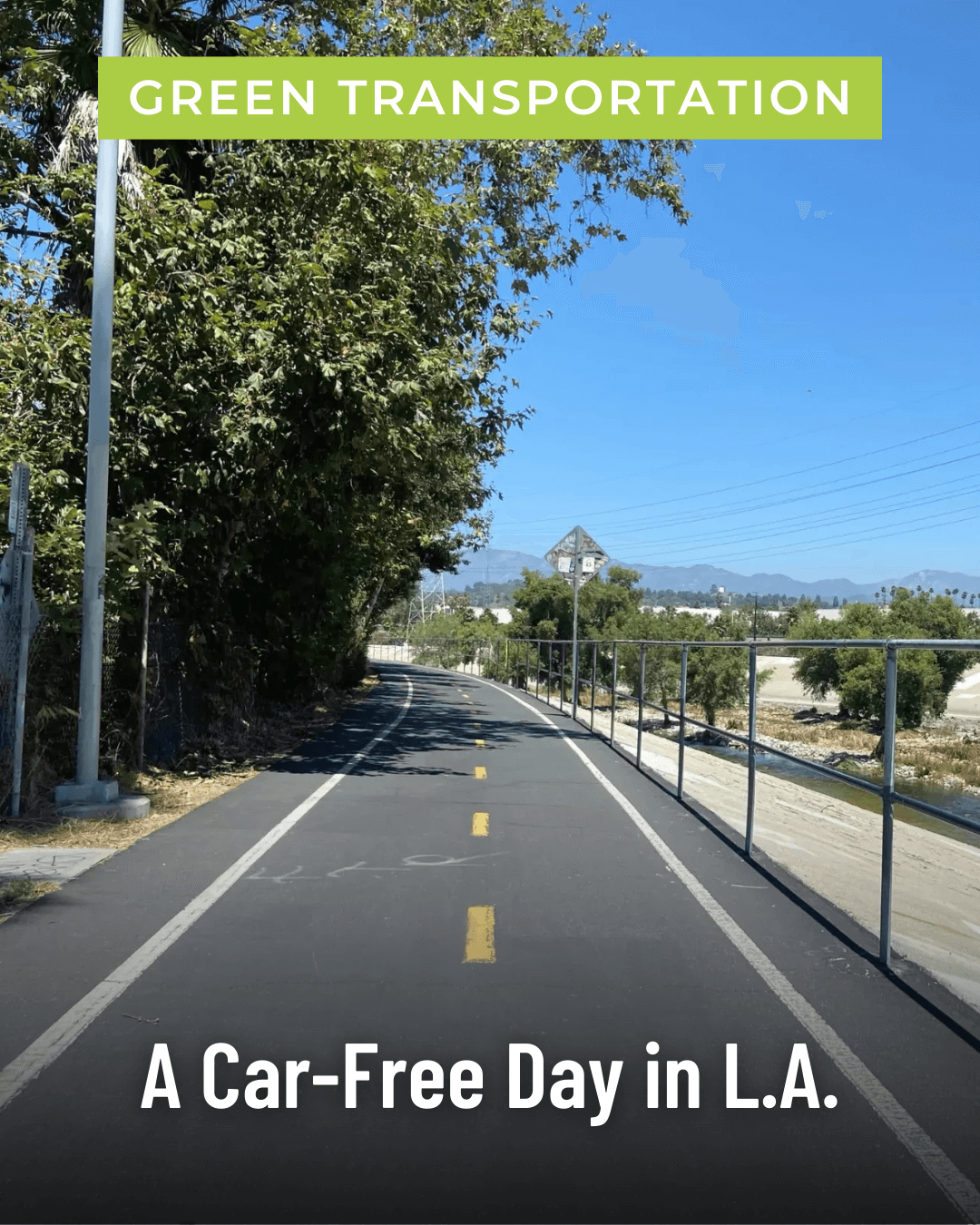
What if you could turn a suburb into a pedestrian-friendly neighborhood? What if cracks in concrete could heal themselves? What if you could ditch your car on a daytrip to downtown Los Angeles? You can, thanks to municipalities, scientific researchers, and local businesses working together to make cities greener.
|
|
|
|
|
|
|
|
|
|
This classic Super Bowl food gets a planet-friendly upgrade with a few simple swaps: plant-based butter, vegan ground meat, and vegetable bouillon. Your guests will never know the difference, because the real stars of this dish are the six different chilies and the variety of spices, not the meat.
Get the recipe.
Serve with dairy- and egg-free cornbread!
|
|
|
|
|
|
|
 |
|
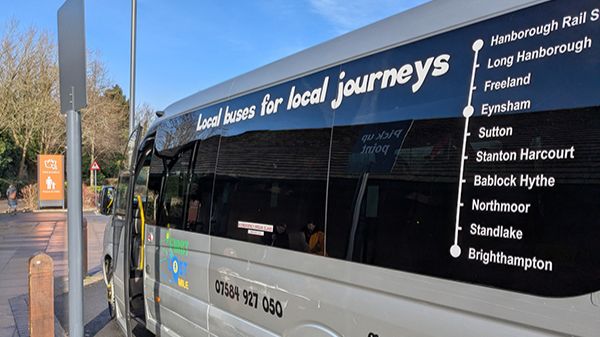
When a regular bus route got canceled in rural England, the locals got together and created their own. Bluedot contributor Chris Manktelow tells us how The First and Last Mile was created to provide a low-carbon lifeline. A trip to town now includes a bus ride with your buddies.
|
|
|
|
|
|
|
 |
|
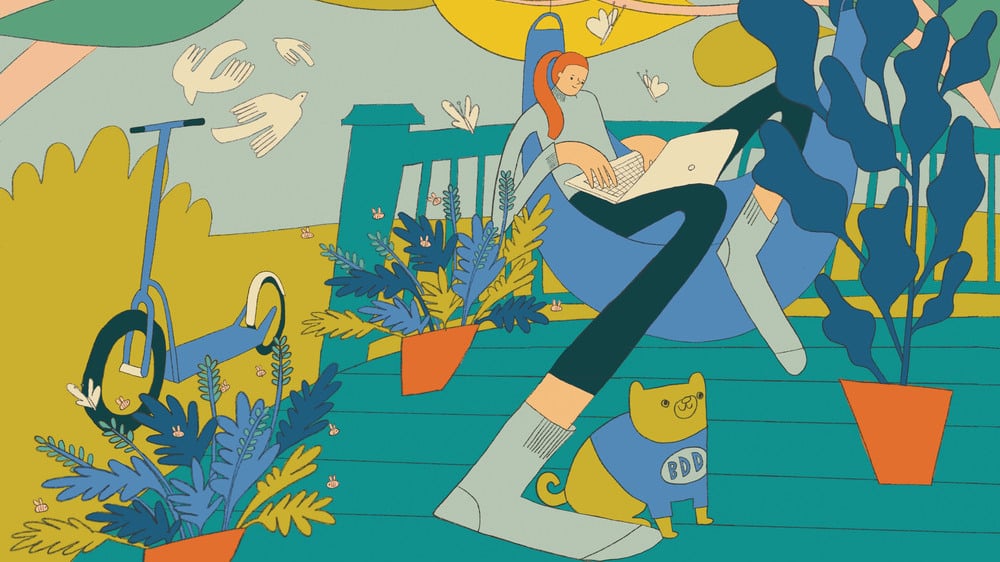
Illustration by Elissa Turnbull |
|
Dear Dot,
I’ve heard that bike transit could really help fight climate change, but New York City sometimes feels very anti-bike (and dangerous!). Why aren’t cities embracing bicycle infrastructure?
–Kyle, Brooklyn
Dear Kyle,
When cycling is used to replace fossil-fuel-powered transport, it can put a dent in the warming of our planet. It could also reduce the amount of pollution we breathe and the level of noise we are subjected to; plus it contributes to improved mental and physical health (and therefore reduced healthcare costs).
With all this good, Kyle, you ask a fair question: Why aren’t our cities building more robust and safer infrastructure?
When Dot first responded to this question, Kyle, the Inflation Reduction Act (IRA) was distributing funding to a number of pro-bike initiatives (not to mention EV infrastructure, green building initiatives, incentives for energy-efficient appliances and much more). Alas, the current administration put the IRA in a grave. But good news, Kyle! The folks at People for Bikes, the advocacy group that was so enthusiastically embracing IRA funding opportunities, is moving ahead with plenty of infrastructure projects with the goal to make the U.S. the most bike-friendly country on Earth. (America has definitely got some catching up to do!)
None of this matters, of course, if companies and communities don’t take advantage of what’s offered. But lots of communities — including New York City where you write from — are building better bike infrastructure. And that’s because of people like you and me, Kyle, who keep agitating for change. What can we do? Keep reading. |
|
|
|
|
|
|
|
|
|
|
|
|
|
If you make a purchase through our links, including from Amazon, we may earn a small commission. |
 |
|
|
|
|
|
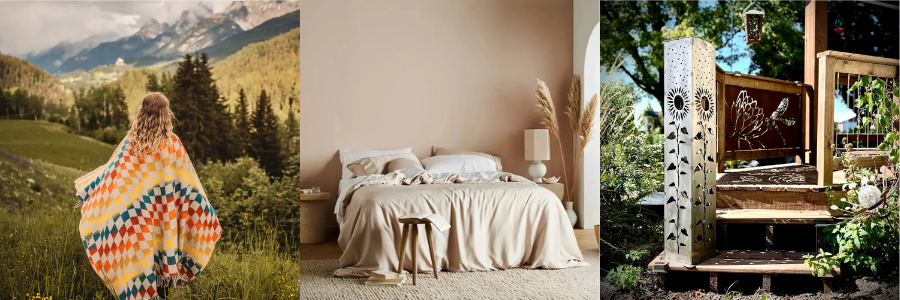
A memorable Valentine’s Day gift doesn’t need to be loud or lavish. In fact, the best gifts tend to be the ones that quietly fold into daily life — the sheets you climb into at night, the blanket pulled close during a movie, or a small, beautiful object that serves as a steady reminder of care and connection. Use code SIGNUP10 for 10% off your first purchase from our store.
|
 |
|
|
|
|
|
There’s something undeniably intimate about fresh sheets — especially when they’re impossibly soft. Ettitude’s CleanBamboo bedding feels cool, silky, and breathable, with a drape that instantly elevates your bedroom. If you’re looking for a Valentine’s gift you’ll both enjoy every single night, this is it. Nothing says “I love you” quite like better sleep. (Pillowcases from $65, queen sheet sets from $365). Shop now.
|
|
|
|
Sackcloth & Ashes’s recycled wool blankets are made for slow mornings and cozy nights, with timeless designs you’ll reach for year after year. For every blanket purchased, the company donates a blanket to a homeless shelter. (From $126) Shop now.
|
|
|
|
Northern Forge’s steel luminary pillars will add a special touch to your outdoor space for years or decades to come, a quiet yet bright reminder of your love. Handcrafted in Wisconsin, the solar-powered steel pillars come in a range of designs to suit your tastes. Order now for free shipping. (From $38) Shop now.
|
|
|
|
Paid Advertisement |
|
|
|
|
|
|
You have a powerful vision—an idea for the world, a business, an organization. **Let's make it real**. |
 |
|
Rooted Insight helps entrepreneurs turn ideas into structured, actionable plans that drive growth—while thinking beyond just the next step. Let's talk about what's next. |
| Schedule a Free Consultation |
|
|
|
What You Can Do:
Build Community Resilience |
|
Ready to build community resilience? Dot created a guide (including recipes for a potluck gathering) with all you need to know. Don’t get Daily Dot in your inbox with your dose of simple solutions, good news, and ideas from around the world? Subscribe now.
|
|
|
|
|
The Keep-This Handbook |
|
We just know that you’ve got a broken toaster or kettle, or ripped jacket, or … something in your house that needs repair. How? Because our story on Repair Cafés is one of our most-read. Here’s how to find a Repair Café in your community, and here’s more information about the Right to Repair legislation that is gaining strength and popularity.
|
|
|
|
|
|
|
|
This past week, I sat in a darkened theater, not a single seat empty, for a screening of H is for Hawk, based on the award-winning memoir by British writer Helen Macdonald about grief and a goshawk named Mabel. Afterward, one of the film’s screenwriters, bestselling novelist Emma Donoghue, answered audience questions, including one that I found particularly compelling: What, the questioner wanted to know, was special about seeing a film on the big screen?
Donoghue sat up a little straighter and leaned forward. “Oh!” she replied, clearly delighted by the question. This screening, she told us, was her first big-screen viewing of the film she helped write, and she was surprised at how much laughter there was, given that the subject matter was so serious. But that’s the thing, she said. Our responses are amplified in a crowd, we get carried away by each other’s enthusiasm. A film in a theater is a collective experience.
As we all gathered our coats after the Q and A and ventured into the cold evening, I heard snippets of conversation around me — about the film itself, the book it was based on, the conversation that followed. About the clear night, the chaotic parking lot. I hadn’t just watched a film, I’d been part of something. It felt good.
Bluedot Living has been lucky to be able to talk with a filmmaker who’s made impactful and magical films. Adam Leipzig, who gained fame as the producer of Dead Poets Society, went on to make Plastic Ocean and March of the Penguins. Bluedot founder Victoria Riskin talked to Adam about how films change the climate story for our Imagine If podcast. Listen to it on YouTube, Apple, or Spotify.
Enjoy the Super Bowl and Olympics if you’re watching (or find a group and gather together to watch!), and we’ll see you next week.
– Leslie Garrett (and Emily Cain, Robin Jones, and Jamie Kageleiry)
Editors
Write us at editor@bluedotliving.com |
|
|
|
|
 |
|
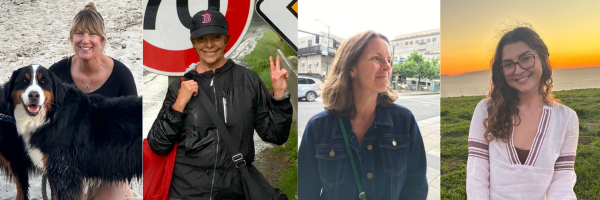
Leslie Garrett has been covering climate stories for close to two decades. She makes her home in Canada, west of Toronto. She’s still figuring out her favorite spot but it’s definitely near the water.
Jamie Kageleiry, a longtime magazine and newspaper editor from Martha’s Vineyard, says her favorite spot on earth is out on a kayak there, looking at birds.
Robin Jones is a Southern California native who served as an editor at Westways magazine for more than a decade. She lives in Long Beach and teaches journalism at Cal State Long Beach.
Emily Cain is a recent graduate of Cal State Long Beach, where she wrote and edited for the university’s award-winning magazine, DIG. |
|
|
|
|
|
Our audience is informed, intentional, and tuned in to sustainable living. Reach our 300,000 readers by advertising here, or contact adsales@bluedotliving.com to reserve your space. |
|
|
|
|
|
|