|
|
|
|
|
|
|
Welcome to Your Daily Dot where Dot will share tips, advice, and stories on how we can make our world better. |
|
|
|
|
|
If you purchase anything via one of our links, including from Amazon, we may earn a small commission.
All Dear Dot illustrations by Elissa Turnbull. |
|
|
 |
|
|
|
Dear Reader,
Rolling our eyes at how often our weather forecasters get it wrong is a national pastime. But the truth, according to a weather forecaster, “lies in the tricky nature of meteorology. It's a delicate science, and any tiny inaccuracy in the data can skew things — or knock them out of shape.” Otherwise known as “the butterfly effect,” these tiny errors in data collection can produce wildly different forecasts.
And yet, forecasts are more accurate than ever before, thanks to technological advances. (Our experience that forecasters seem more often wrong than right is a negativity bias: We remember when they’re wrong but pay less attention when they’re right.) But complex data is hard to distill into a general, short forecast. Making things even harder, as John Morales explained, “the cuts to NOAA and the National Weather Service have been devastating. … and day-to-day forecasting has become more challenging.”
The result? A skeptical and cynical audience that’s less prepared for the impacts of extreme weather. And more meteorologists are quitting their jobs because they are being asked to downplay or ignore the role of climate change. As veteran NBC climate reporter Chase Cain recently said, “We know that oil is making the planet hotter. I don’t need the oil company to lie to me and say that it’s not.”
But back to accuracy.
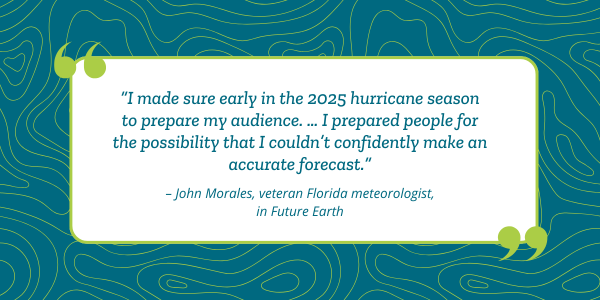
Some forecasters respond by “over-warning,” Morales explains. However, as noted in his quote above, he tried to explain to his audience that he couldn’t confidently make predictions, because about 20% of formerly available data isn’t available any longer, due to the cuts.
It’s a dangerous time to be reducing the information available to those we rely on to warn us about extreme weather events. “The black swans and gray swans [rare, unusual, high-impact climate events] are starting to happen. Now combine that with a degraded ability to monitor and forecast. That’s an incendiary mix. People’s lives are in danger because of what’s happening right now,” Morales said.
So what do we do? Morales’ advice lines up with that of many other climate scientists. Talk with friends and family and neighbors about climate changes you’re seeing and how it’s impacting what you love. What’s more, by talking openly with each other about climate changes and the resulting extreme weather we’re seeing, we’re more likely to take weather threats seriously. As Morales said, “sometimes the worst does happen. … The element of surprise needs to be taken into account. You cannot lean so much on your life experience.”
Stormily,
Dot
|
|
|
|
|
 |
|
This season’s issue is all about cooking with intention, using what you have, and setting the tone for a more thoughtful spring. We’re sharing waste-not soup and a closer look at planet-conscious chocolate. You’ll also find guidance on raising backyard chickens, what to know about amla powder, and ideas to help you cook seasonally while we head into spring. Subscribe now to read the latest issue of Bluedot Living Kitchen and get a full year of low-waste recipes, sustainable kitchen tips, and mindful cooking inspiration for every season.
|
| Subscribe Now |
|
|
|
|
|
|
|
|
|
|
|
|
|
|
|
|